
Forest Whisper Wellness and Healing
Nature-Based Therapy
Reclaim Roots, Connection and Wholeness - Mind, Body, Spirit held by Creation
Individual Nature-Based Therapy (Adults & children 8+)
Do you feel like you’re holding it together on the outside, while inside you’re exhausted, anxious, or hurting in ways you can’t keep pushing through?
Do you have children who carry big feelings, big energy, or quiet worries they don’t yet have words for?
My individual therapy sessions meet you, or your child, or partner or family exactly where you are — gently, slowly, and without pressure. We move at the pace of your nervous system, not a timeline, creating conditions where steadiness, capacity, and connection can grow.
Imagine having space to:
-
Settle your nervous system so your grounded, authentic self has room to show up
-
Understand patterns that keep you stuck in overwhelm or reactivity
-
Develop coping skills that fit real life, not just theory
For children: space to name feelings, understand outbursts, practice regulation, and build safe, healthy ways to cope
For both: to feel seen, supported, and more equipped to navigate daily life
What sessions look like
-
A calm, supportive setting outdoors in St. Paul and Roseville MN parks
-
Somatic work, parts work, experiential and play-based interventions, nature-based tools, grounding exercises, and reflective conversation
-
Neuro-affirming langugage and practices
-
Faith can be thoughtfully integrated if you desire
-
Therapy dog support available for children when helpful
-
Sessions are 50–60 minutes
This is clinical psychotherapy grounded in trauma-responsive, nature-informed care. Service is provided through St. Paul Nature-based Therapy in St. Paul, Roseville and beyond.
Private pay and insurance options available.
*While therapy can be deeply supportive, it is not a crisis service; if you are in immediate danger or need urgent help, call 991 or crisis lifeline 988.

Animal-Assisted Therapy

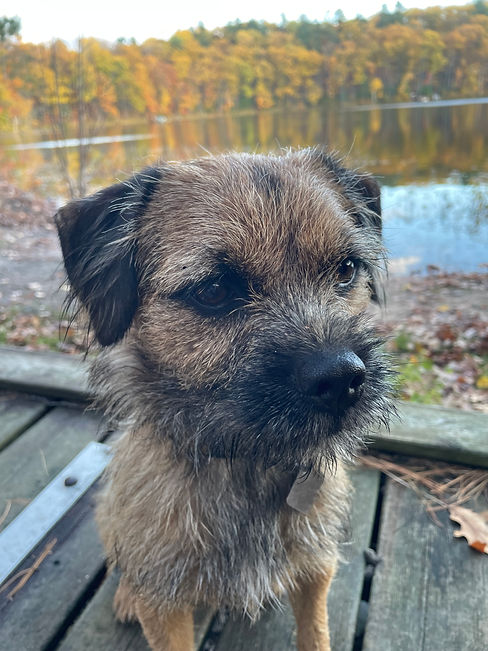
Why therapy with dogs
Manchmal ist es einfacher, schwierige Dinge in Gegenwart eines Therapiehundes zu verarbeiten. Sie geben uns Sicherheit und helfen uns, uns zu regulieren.
Es gibt auch Therapiehundegruppen. Bitte kontaktieren Sie mich, wenn Sie an einer Gruppe für psychische Gesundheit interessiert sind, die mit Therapiehunden arbeitet, oder an einem individuellen Behandlungsplan für psychische Gesundheit mit einem Therapiehund.
Sie möchten lieber eine naturnahe Therapie ohne Hunde machen? Schauen Sie sich hier unsere Möglichkeiten an.

Bailey and Pika
Bailey ist ein 2 Jahre alter, intelligenter Boarder Terrier, der gerne mit Menschen arbeitet. Er ist ein ausgebildeter Therapiehund, der bereits seit einem Jahr ehrenamtlich in Schulen über Canine Inspired Change arbeitet.
Pika ist ein einjähriger Soft Coated Wheaten Terrier und liebt es, Menschen zu gefallen und ihre flauschige Liebe mit ihnen zu teilen. Sie macht in diesem Frühjahr eine Ausbildung zum Therapiehund.
Mit welchem Hund Sie arbeiten, hängt von Ihnen ab und davon, welcher Hund Sie während Ihrer Therapiesitzung am besten unterstützt.

Focused Therapy Intensives
More time to explore what matters. More space to reconnect with yourself.
Sometimes, an hour of therapy feels too short.
Just as you begin to settle in, find the words, or understand something important, it is time to stop and return to the rest of your day.
Maybe there is a recurring pattern you are tired of living with. A relationship that leaves you feeling confused. A transition you are struggling to navigate. Or a sense that you have lost touch with yourself somewhere along the way.
You may understand a lot about why things are the way they are, yet still find yourself wondering:
Why do I keep ending up here?
What am I not listening to within myself?
How do I move forward in a way that feels right for me?
A focused therapy intensive offers dedicated time to explore one or more of these questions in greater depth.
Not to rush you toward an answer, but to give you room to understand, experience, and discover.
What is a therapy intensive?
A therapy intensive is an extended psychotherapy session, typically lasting 3–4 hours, with breaks and time to pause.
Rather than spreading the work across several weekly appointments, we set aside a larger block of time to focus on something important to you.
We begin with what you are experiencing and what you hope to understand or change. From there, we follow the process together.
Sometimes this means talking and making sense of your experiences. Often it means slowing down to notice what is happening in your body, exploring different parts of yourself. And we will be stepping outside and allowing nature to become part of the conversation.
There is no fixed formula. The intensive is shaped around you, your needs, and what emerges during our time together.
How can an intensive be helpful?
When you feel stuck in a familiar pattern
You may know that a pattern is not serving you, but understanding it has not been enough to change it.
With more time, we can explore what happens beneath the pattern: what you are protecting, what you need, and what makes it difficult to respond differently.
When you are carrying a lot inside
Sometimes there is so much happening internally that it is hard to know where to begin.
An extended session gives us time to slow down, untangle what feels overwhelming, and make space for the different feelings, needs, and experiences you carry.
When you are at a crossroads
A life transition can leave you feeling uncertain about who you are and where you are going.
An intensive can offer space to listen inward, explore what matters most, and begin finding a direction that feels more aligned with you.
When you long to feel more like yourself
Perhaps you have spent years meeting expectations, caring for others, or trying to be the person you thought you should be.
You may be longing to reconnect with your own needs, values, creativity, and sense of aliveness.
An intensive creates space to explore who you are beneath the roles and responsibilities.
Nature is a partner in the work
Nature is not simply the setting for these intensives. It is an active partner in the therapeutic process.
We may spend time walking through the woods, sitting beneath a tree, noticing the changing landscape, or pausing with the natural world around us.
Sometimes nature gives us a different way to approach something that feels difficult to put into words.
Sometimes movement and sensory experience help us notice what is happening within us.
Sometimes a quiet moment outdoors offers a kind of spaciousness that is hard to find in everyday life.
The natural environment does not need to provide an answer or a metaphor. It offers us another way to experience the moment, connect with ourselves, and explore what is meaningful.
What does an intensive look like?
Every intensive is different, but here is an example of how our time might unfold.
1. Arriving and settling in
We begin by taking time to arrive, get comfortable, and talk about what you are bringing into the day. There is no need to jump straight into the difficult stuff.
2. Exploring what matters
We spend time understanding the theme you have chosen. This may include talking, sensing, experiencing somatically, reflecting, exploring patterns, or noticing the different parts of yourself involved.
3. Partner with Nature
Nature becomes part of our exploration. We may walk, pause, observe, move, create or engage in a simple experiential activity that connects with what we are working on.
4. Pausing and integrating
We take breaks as needed. We allow time to notice what has shifted, what feels important, and what you want to carry forward.
5. Finding a way forward
We end by reflecting on what you have discovered and identifying small, meaningful steps that may support you in everyday life.
The process is not about reaching a dramatic breakthrough. Sometimes the most meaningful change is a little more understanding, a new way of relating to yourself, or the realization that you have more choice than you thought.
Is an intensive right for you?
An intensive may be a good fit if you:
-
Have a particular theme or life situation you want to explore
-
Feel ready to devote focused time to your own wellbeing
-
Want to combine conversation with experiential and nature-based work
-
Prefer a longer session rather than several shorter appointments
-
Are curious about understanding yourself in a deeper or different way
An intensive is not necessarily the right format for every person or every concern. We will begin with a conversation to understand your needs and determine whether this approach is appropriate.
Practical details
Length: Typically 4 hours, including breaks plus one hour preparation consultation and one hour follow-up session on different days, total of 6 hours.
Format: Individual psychotherapy, private pay
Investment: $850 incl. preperation consultation and follow-up integration session.
Setting: Outdoors in a park. We will discuss together what the best place will be
Preparation: An initial conversation to identify your goals and prepare for the session
After the intensive: Time to reflect and integrate what you have explored, with follow-up support discussed as appropriate
A little more room for yourself
You don't have to know exactly what you need before reaching out.
You can come with a question, a feeling, a pattern you are tired of, or simply the sense that something in your life is asking for attention.
We will begin there.
There is no need to fix yourself before you come.


Why Choose This Approach
-
Because I don’t see you as a “diagnosis” or a “problem to fix.” I see you as someone whose nervous system, body, soul, and life story deserve a safe, compassionate, grounded space with nature as your partner to breathe, heal, and remember who you truly are.
-
Because healing isn’t just about coping. It’s about reconnecting to yourself, to your values, to the earth, to rest, to rhythm, to what matters.
-
Because transformation doesn’t always come from “doing more,” but from “slowing down,” “listening,” and “being” often with the guidance of the forest, seasonal rhythms, and sensory awareness.
-
Because I respect your faith, your spiritual longings, and your desire for meaning and will integrate them only if you want.
Frequently asked questions


Landanerkennung
I recognize my Swiss Identity shaped me in how I understand cultures. Working in America brought me in touch with the hurtful reality many people suffered through Europeans coming to this land and claiming it. When working in America I acknowledge that the land I do my work on, was stolen from the indigenous people who lived here already long before European explorers believed to have discovered new land, settlers came and colonies were build. In a treaty in 1851 the US government took the land from the Dakotas. I therefore want to recognize on my walks the land we get to stand on with gratitude and understanding that this is stolen land and belongs to the Dakota people. Learn more about the Land we are on on Native Governance Center.